News
4 of 9 Boston Universities List No Phone Charging Option
Two of nine Boston universities let a phone open dorm doors, and four list no phone charging option. A school-by-school check of IDs and charging.
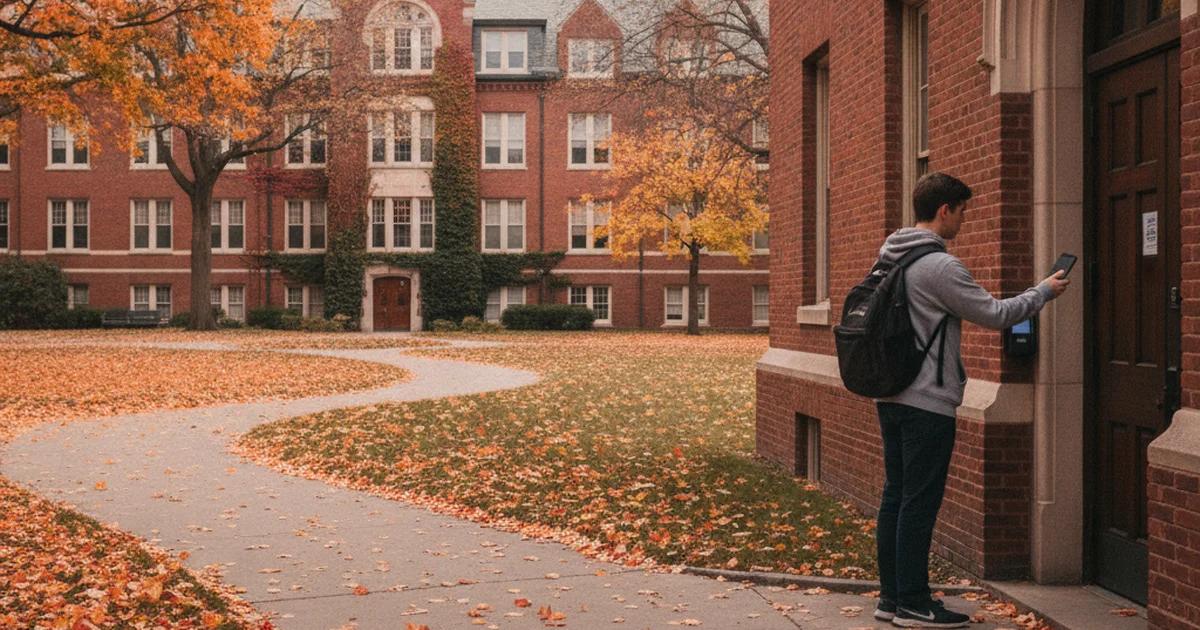
A dead phone used to mean a missed text. On some campuses it can now mean a locked residence hall door. Northeastern University's Husky Card office tells students they can "use your phone in place of your Husky Card," and MIT says its Mobile ID "can be used just like a physical ID card on campus to access spaces, make purchases, and release print jobs." Both still issue plastic cards, but the phone is now a key.
That raises a practical question for a city full of college students: if a school asks students to carry their ID on a phone, does it also tell them where to charge it? The Daily Bostonian checked the card office pages and library pages of nine Boston-area universities in November 2026 to find out.
Which Boston schools put the ID on the phone
Two of the nine schools publish a phone credential that opens doors.
At Northeastern, students download the GET Mobile app, sign in with their university account and Duo, and can then open "your room and other approved spaces on campus" and use meal swipes at residential dining locations, a feature the page marks as Boston only. Opening a door takes several steps on a live phone: unlock the app, allow location access, pick the door, tap Activate, then key a PIN into the lock.
At MIT, the MIT Mobile ID launched in fall 2021 through the MIT Atlas app on iPhone, Apple Watch and Android. MIT News reported that about half of first-year students turned it on the first day it was offered, that more than 14,000 community members had enabled it within months, and that Mobile IDs were used for almost 50,000 transactions in October 2021, not counting building access. The IS&T service page notes that some Access MIT Pass transit benefits may still require the physical card.
The other seven schools still describe a physical card as the credential. Boston University's Terrier Card page says the card is used "for swipe access into residence and dining halls" and "must be carried at all times." The UMass Boston BeaconCard must be kept "on their person at all times when on campus." Tufts' ID card policy says the card is required for admission to residence halls and dining halls. Boston College's Eagle One Card, Harvard's ID card and Berklee's ID badge are all described as physical cards that open buildings.
Suffolk is the closest call. Its Ram Card page uses the same GET Mobile app for photos, funds and balances, but says the Ram Card itself "is essential and required on campus." We counted it as a physical card school.
What the schools publish about charging
The second question: does the school, on a library or campus page, tell students where to charge a phone? We counted charging stations, phone charger loans and battery loans, not ordinary wall outlets.
Five of the nine publish something.
- Northeastern: Snell Library's FAQ says patrons can borrow Omnicharge portable battery packs to use at their seat, from stations on the library's fourth floor. Students have to bring their own cable.
- Boston College: the library's charging FAQ, updated in December 2025, lists locking phone charging stations at seven spots across four libraries: four in O'Neill Library, and one each in Bapst, the Social Work Library and the Theology and Ministry Library. Students plug in, set an access code and lock the phone inside. O'Neill's main circulation desk also lends iPhone and Samsung chargers for four hours. The library's station guide says each KwikBoost unit charges up to eight phones at a time.
- Tufts: Tisch Library lends a USB-C charger described as compatible with laptops, iPads and phones, for up to eight hours, plus a micro-USB charger for Android phones.
- Berklee: the Stan Getz Library lends "phone and computer chargers" and "portable battery packs" for four hours.
- Suffolk: Sawyer Library's equipment page lists iPhone and Android chargers, checked out with the Ram Card.
Four do not, on the pages we could find. Harvard's Tech Loan page says many libraries lend "basic gear like headphones and laptop chargers," and the Lamont and Cabot list names USB-C and MagSafe laptop chargers, but none is described as a phone charger. We found no phone charging station or phone charger loan on the library or campus pages of Boston University, MIT or UMass Boston.
The numbers, school by school
Enrollment figures are total fall 2024 enrollment from the U.S. Department of Education's College Navigator (IPEDS), the latest year published.
| School | Fall 2024 enrollment | Phone works as campus ID? | Published phone charging option |
|---|---|---|---|
| Boston University | 37,737 | No. Terrier Card "must be carried at all times" | None found |
| Northeastern University | 32,553 | Yes. GET Mobile app opens rooms and covers residential dining (Boston) | Omnicharge battery packs, Snell Library 4th floor |
| Harvard University | 30,259 | No phone credential on ID Card Services page | Laptop chargers only; no phone charger listed |
| UMass Boston | 15,575 | No. BeaconCard kept on person at all times | None found |
| Boston College | 15,432 | No. Eagle One Card | 7 locking charging stations in 4 libraries; iPhone and Samsung chargers, 4 hours |
| Tufts University | 13,599 | No. Card required for residence and dining halls | USB-C charger for phones, up to 8 hours, Tisch Library |
| MIT | 11,886 | Yes. MIT Mobile ID on iPhone, Apple Watch, Android | None found |
| Berklee College of Music | 8,369 | No. ID badge | Phone chargers and battery packs, 4 hours, Stan Getz Library |
| Suffolk University | 6,356 | No. GET app for accounts; Ram Card required | iPhone and Android chargers, Sawyer Library |
| Total | 171,766 | 2 of 9 schools (44,439 students) | 5 of 9 schools (76,309 students) |
Source: school card office and library pages, read November 2026; enrollment from NCES College Navigator, fall 2024. "None found" means no phone charging station, phone charger loan or battery loan appeared on the school's library or campus pages we checked; it does not rule out outlets or unlisted services. Emerson College's site blocked automated reading during the check, so Emerson is not included.

Chart: The Daily Bostonian analysis of school card office and library pages, checked November 2026. Enrollment is total fall 2024 enrollment from NCES College Navigator.
The pattern does not follow size. Four of the nine schools publish no phone charging option, and they enroll 95,457 of the 171,766 students surveyed (55.6%), while the two schools that let a phone open doors cover 44,439 students (25.9%). The three largest schools by enrollment, Boston University, Northeastern and Harvard, split three ways: one has a phone ID and a battery loan, one has neither, and one lends laptop chargers only.
Berklee and Suffolk, the two smallest schools surveyed, both lend phone chargers. Boston College publishes the most detailed setup.
When the battery runs out
Whether a dead phone locks a student out depends on how the ID is stored.
Apple says a student ID added to Apple Wallet turns on Express Mode automatically, so the phone does not need to be unlocked at the reader. On some iPhone models, Apple's power reserve feature lets Express Mode cards keep working "for up to five hours" after the phone needs a charge, as long as the phone has not been switched off. MIT News says MIT's Mobile ID can be kept in Apple Wallet.
Android is less forgiving. Indiana University, which offers its campus card in Google Wallet, tells students on its Android help page that the phone "must be powered on and 'awake' (display active)" for the digital card to work.
App-based credentials are the strictest. The Northeastern door sequence above runs inside the GET Mobile app and asks for a PIN, location access and a tap on Activate, all of which need a phone that is on.
The fallback is the plastic card, and the offices that replace it keep business hours. Northeastern's Husky Card office in Speare Commons is open Monday to Friday, 8:30 a.m. to 4:30 p.m., and its FAQ lists a $25 lost ID fee. BU's Terrier Card Office is open weekdays from 9 a.m. to 5 p.m. and charges $40 for a replacement. UMass Boston's BeaconCard office is open Monday to Thursday and by appointment on Fridays. None of them help at 11 p.m.
Transit has moved to the phone, too. Since August 1, 2024, the MBTA has accepted tap payments from phones and watches at every gated subway station and on buses and Green Line trolleys, Boston.com reported, and students in reduced fare programs can link their benefits to a phone. A student who rides the T, eats on a meal plan and opens a dorm door with the same device has three reasons to keep it charged.
How campuses usually solve it
Boston schools already use two of three common answers.
Fixed charging lockers. Boston College's KwikBoost stations charge a phone in a locked bay. The student has to leave the phone behind, which is awkward when the phone is also a door key.
Desk loans. Tufts, Berklee, Suffolk and Boston College all lend chargers, and Northeastern and Berklee lend battery packs. This works when the library desk is staffed, and listed loans run four to eight hours.
Self-serve power bank rental. A third model puts a kiosk of portable batteries in a union or library, and students rent one, carry it to class and return it at any station. ChargerGoGo, which sells a phone charging station for universities, says its stations go in "libraries, common areas, and academic buildings." In a case study on its own site, the company says UCLA, with more than 45,000 students, previously relied on fixed charging lockers that "required students to leave their phones behind," and that it placed stations at the UCLA Store in Ackerman Union and in Health Sciences buildings. Its venue operators page offers stations to hosts free, with lost battery replacement and revenue sharing listed. None of the nine Boston schools listed a self-serve rental kiosk on the pages we read.
What students can do now
- If your school offers Apple Wallet: keep the ID in Wallet rather than only in an app, and do not power the phone off when the battery warning appears. Apple says power reserve is not available once the phone is turned off.
- If your ID lives in an app, as at Northeastern: carry the plastic card as a backup. The app needs a working phone at the door.
- Know your library's loan desk. Boston College, Tufts, Berklee and Suffolk lend phone chargers; Snell lends batteries, but bring a cable.
- At BU, Harvard, MIT and UMass Boston, carry a pocket battery.
Boston's universities are moving the student ID onto the phone at different speeds. The gap is in the second step. A school that turns a phone into a key has made battery life part of building access, and only some of them have said where students can plug in.
Sources
- Northeastern University Husky Card Services: GET Mobile App
- Northeastern University Husky Card Services: FAQ
- Northeastern University Library: charging at Snell Library
- MIT News: MIT ID cards go digital (December 2021)
- MIT IS&T: MIT ID
- Boston University Terrier Card Office
- Harvard Campus Service Center: ID Card Services
- Harvard Library: Tech Loan and Lamont and Cabot equipment list
- UMass Boston: BeaconCard
- Boston College: Eagle One Card, Library FAQ on phone charging and O'Neill charging station guide
- Tufts University: ID card policies and Tisch Library USB-C charger
- Berklee: One Card (Berklee ID) and Stan Getz Library equipment
- Suffolk University: Ram Card and Sawyer Library equipment and services
- NCES College Navigator, fall 2024 total enrollment for each school
- Apple Support: Add your student ID to Apple Wallet and Express Mode with power reserve
- Indiana University: digital CrimsonCard on Android
- Boston.com: MBTA contactless payment launch (July 2024)
- ChargerGoGo: universities page and UCLA case study (August 2025), read November 2026
About the author
Nadia Osei
Nadia Osei writes about research, culture and sport for Daily Bostonian: the universities and teaching hospitals, the museums and music, and the teams that set the mood of a Boston week.